(Photographer: Graeme Sloan/Bloomberg via Getty Images)
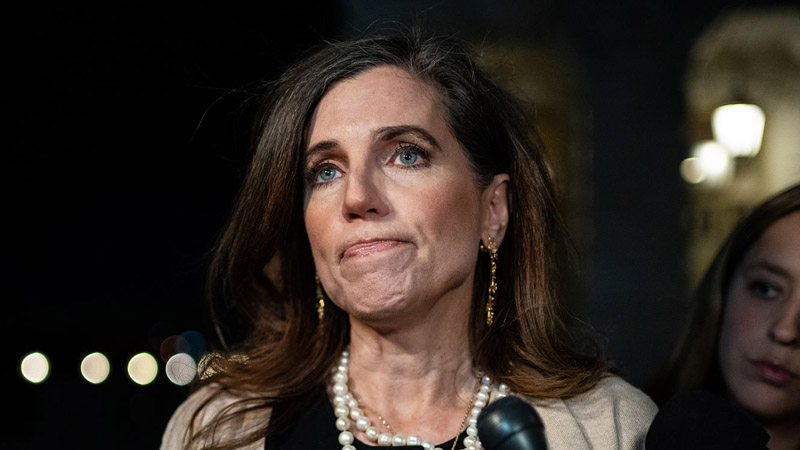
Rep. Nancy Mace of South Carolina brushed aside a report on Wednesday claiming she was weighing whether to resign from Congress while she launches a campaign for governor. Her answer came in a single word, after CNN’s Manu Raju asked her directly about a New York Times story that said she was considering stepping down.
According to the Times article, Mace’s dissatisfaction with the way Republican leadership handles women in the party has increased. Additionally, it stated that she had discussed leaving Congress early with Representative Marjorie Taylor Greene.
Her worries were presented in the story as part of a larger divide with GOP leaders that has been growing over the last several months. Mace’s outspoken criticism of fellow Republicans on the handling of the Jeffrey Epstein materials has been a major source of conflict. She has broken with party officials who favor a more circumspect approach and pushed for greater transparency.

Her position on that issue, combined with her earlier willingness to oppose President Donald Trump, has created friction within the GOP. Mace’s political path has never been straightforward. After the Jan. 6 attack on the Capitol, she condemned Trump’s role in the events and voted to certify the 2020 election results.
She was one of the Republicans calling on the party to abandon the president at the moment. However, she has now supported several of Trump’s policy objectives, especially those about economic issues and immigration enforcement. Although the disagreements between her and Trump’s inner circle were never fully addressed, her alignment on those topics helped her regain some support from conservative supporters.
The Times reports that she feels the GOP leadership’s handling of conflicts with women in the party is the source of the most recent tension. The story stated that Mace has become weary of what she perceives to be a double standard, although it did not identify any particular politicians or instances. The publication was also informed by those close to her that she has considered in private whether remaining in Congress is beneficial or detrimental to her long-term goals.
Raju’s interaction with Mace on Wednesday served as her first public response to the report. Her direct “no” indicated that she intended to remain in her position while running for governor, at least for the time being. Although she hasn’t issued an official statement explaining her explanation, the succinct response implies that she doesn’t want to further complicate her already complicated political circumstances.
Her future is still up in the air, though. According to The Times, the White House recently cautioned Mace that if she continues to distance herself from Trump, her electoral chances may suffer. The warning illustrates the realities of running for statewide office in a Republican-led state where Trump still has sway, even though it isn’t a direct threat. Mace has attempted to strike a balance between independence and political pragmatism, although both parties have frequently criticized that strategy.
She continues to serve in Congress, navigating conflicts within her own party while running for governor. Although the rumors may be momentarily subdued by her prompt rejection of the resignation report, the fundamental conflicts that gave rise to the allegations remain unsolved. Her future actions and the amount of room she has to forge her own path inside the Republican Party will probably depend on whether those demands intensify as the campaign progresses.
Nancy Mace’s Political Career
Milestones, elections, and headlines are frequently used to characterize Nancy Mace, but this framing obscures a crucial aspect of her work. Her comfort level with conflict has created her political identity more than philosophy. She is remarkably open to living in environments where alliances are transient and acceptance is uncertain.
Mace’s tolerance for solitude is one of the features of her job that is rarely acknowledged. She has frequently taken the price of standing alone in a system where survival frequently hinges on rigid devotion. This is not a coincidence. Her public decisions imply that she prioritizes independence over security, even when such independence provokes criticism from both political parties. While many leaders talk about independence, very few truly put it into effect when the repercussions are dire.
A methodical approach is also evident in Mace’s communication style. Instead of focusing on abstract theory, she frequently reduces complicated political conflicts to human concerns. Although this isn’t usually a short-term strategic move, it lends her credibility with those who don’t trust polished messages. She frequently sounds more like someone outlining how she concluded even if that decision is controversial than someone presenting a party stance.
Her approach to treating resilience as a talent rather than a catchphrase is another undervalued aspect of her life. Her history points to a constant struggle between obedience and punishment. When structure helps her become more independent, she welcomes it; when it restricts her ability to make decisions, she opposes it. Her activities might appear contradictory to those who anticipate predictability, but logical to those who perceive her as self-directed because of this balancing.
Nancy Mace’s inability to fit neatly into one category may be what makes her unique. She acts under the idea that self-determination lives longer than political capital. Her willingness to take on risk has quietly emerged as her most valuable quality in an environment that encourages conformity.