
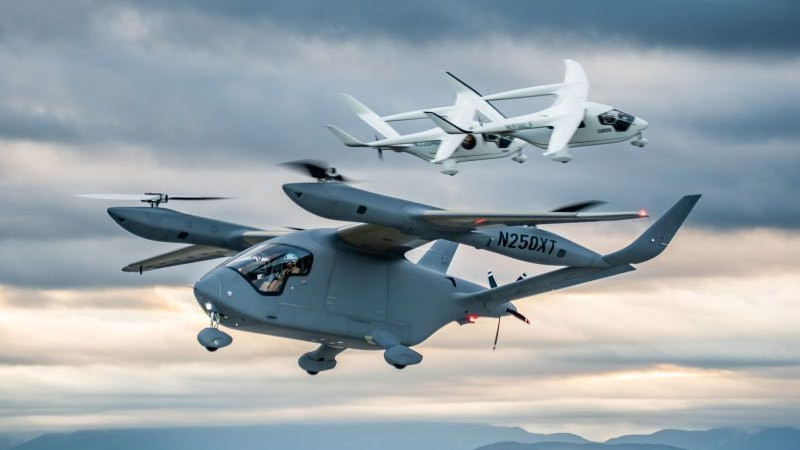
ve Air Mobility Strikes Potential $1 Billion Motor Agreement, Lifting Beta Technologies (Image source: Getty Images)
Shares of Beta Technologies climbed more than 8% on Wednesday after air taxi developer Eve Air Mobility revealed a major supply agreement with the Vermont-based company. Eve, founded by Brazilian aerospace manufacturer Embraer and now operating under Eve Holding, said the partnership could total as much as $1 billion over the next decade.
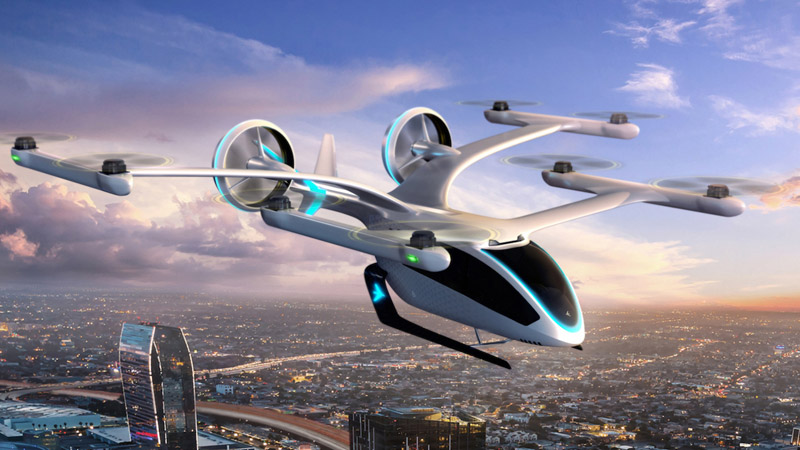
The deal focuses on Beta supplying electric motors for Eve’s planned fleet of aircraft. Investors reacted quickly. Eve Holding shares surged 12% following the announcement, reflecting renewed confidence in the company’s electric vertical takeoff and landing, or eVTOL, program. Eve also highlighted that it currently has a backlog of 2,800 vehicles, underscoring the scale of its long-term ambitions in the emerging air taxi market.
Eve CEO Johann Bordais praised the agreement, calling it a “pivotal milestone” for the company as it moves closer to commercial operations. In a statement, he said Beta’s technology would be central to the performance and reliability of Eve’s aircraft. “Their electric motor technology will play a critical role in powering our aircraft during cruise, supporting the maturity of our propulsion architecture as we progress toward entry into service,” he said.
Beta’s recent move into the public markets has drawn significant attention. The company went public on the New York Stock Exchange last month, backed by investors including Amazon. The share price jump on Wednesday provides a boost following a rocky debut. Beta’s stock has plummeted more than 20% since its IPO, so the Eve relationship is a positive step for both the firm and its shareholders.
The eVTOL business is extremely competitive and in the early phases of regulatory certification. Companies such as Beta, Eve, Archer Aviation, and Joby Aviation are racing to get Federal Aviation Administration approval to begin carrying commercial passengers. Achieving certification has proved to be one of the industry’s most difficult challenges, requiring significant testing, safety validation, and technical advancement.
Air taxi makers are also relying heavily on government collaboration to advance their operations. The industry received a recent boost from President Donald Trump’s announcement of a pilot program intended to support the rollout of eVTOL technology. The project intends to provide organized chances for firms to test their aircraft in real-world settings, which is a vital step before expanding into commercial operation.
International marketplaces have also become strategic battlefields. Rivals Archer Aviation and Joby Aviation have invested extensively in the Middle East, using the area as a testing ground for early deployment. Both firms have collaborated with major military groups and government agencies to show the feasibility of air taxis under extreme environments.

The rivalry between the two escalated further last month when Joby filed a lawsuit against Archer over alleged trade secret misappropriation. While Wednesday’s gains were encouraging for Beta, the company still faces the challenges inherent in a young industry with high costs and long development timelines. Despite the stock’s recent drop, analysts believe that strategic agreements such as the one with Eve will assist to steady its route ahead by establishing long-term income sources.
Eve views the transaction as a significant investment in manufacturing capabilities and reflects confidence in its ambition to deliver eVTOL vehicles to market. As demand for urban air transportation grows and regulatory frameworks evolve, the company anticipates that this arrangement will place it as a leader in an ever-changing aviation market.
Both firms have now turned their focus to execution. With certification races speeding and competition heating up, the next several years will reveal whether eVTOL firms can turn investment excitement into commercial reality.
Busy Beta builds on 100,000nm test milestone
Kyle Clark, the CEO of Beta Technologies, a US electric aircraft company, is a busy guy. The first half of 2025 was frenetic, with the introduction of Beta’s Alia CX300 in a flying demonstration at the Paris air show, but the rest of the year raced up from there, culminating in the company’s successful stock market IPO in November.
It is also worth noting that Clark, rather than being a passive spectator at Le Bourget, was at the controls of the pusher-configured CX300 for many show flights.
However, Clark’s activity has been much outmatched by Beta’s test fleet, which will have flown 100,000nm (185,200km) by 2025, or four times around the world, as the business likes to point out. (At the time of writing, the ticker at the top of Beta’s website indicated that the amount had increased closer to 108,000nm.)
“It’s been a totally transformative period of time for Beta and electric aviation, quite frankly,” Clark tells me. “100,000 [nautical] miles represents a huge amount of flying by the team out in the real world.”