
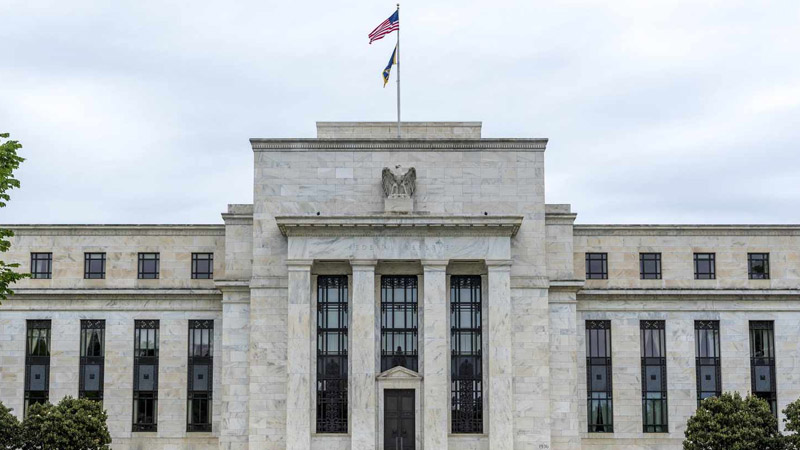
Fed Losses Ease as Lower Rates Help Reverse Long-Running Deferred Asset Build (Richard Sharrocks / Getty Images)
For the first time in nearly three years, the Federal Reserve appears to be inching out of the deep financial hole it fell into during the pandemic-era monetary response. New data shows that the Fed’s deferred asset, a measure that tracks cumulative losses, has started to shrink, marking a small but meaningful shift in a long-standing trend.
Since November 5, the size of the deferred asset has dipped from $243.8 billion to $243.2 billion as of November 26. The change is modest, but analysts say it indicates that the Fed has begun generating enough income to slowly offset its losses. Fed watchers still do not know how long it will take for the central bank to fully cover the deferred asset and return to sending surplus earnings to the U.S. Treasury, a legal obligation. Most estimate the process will take years.
The decline signals a turning point. For nearly three years, the Fed has been weighed down by unprecedented loss-making tied to how it conducted monetary policy after COVID-19 hit. Its balance sheet swelled to historic levels during the crisis, and rising interest rates later created a mismatch in what the Fed earned versus what it was required to pay out.

Bill Nelson, a former senior Fed official and now chief economist at the Bank Policy Institute, said the financial performance of the regional banks suggests the situation is improving. Based on current trends, he said the Fed “appears to be on track for the combined profits of the 12 Reserve Banks to be over $2 billion in the current quarter.”
The deferred asset is an accounting tool that accumulates losses the Fed must offset before it can send money back to the Treasury. Normally, the Fed funds itself through interest earned on its massive bond portfolio and through fees for financial services such as payments and check processing. Any earnings left over are passed to the Treasury, making the central bank a reliable revenue source for the government.
That pattern broke in 2022. The problem began with the Fed’s pandemic stimulus measures. To calm markets and encourage borrowing, the central bank bought huge quantities of Treasury and mortgage-backed securities. Its holdings more than doubled, reaching a peak of $9 trillion in the summer of 2022, as per reports by Reuters.

However, prices went up quickly afterward. Starting in early 2022, the Fed raised interest rates sharply to fight it. Rates went up, so the Fed had to pay banks more interest on funds held at the central bank. At the same time, the Fed kept getting the same amount of money from its older, lower-yielding notes. As a result, the gap grew, which caused the Fed to start losing money every month in September 2022.
Losses look like they’re coming to an end. This is because the Fed no longer has to pay as much interest to banks because of recent rate cuts. It has gone down from a high point of 5.25% to 5.5% in 2023 to a current level of 3.75% to 4%. There have been hints that more cuts might be on the way as officials become more worried about the job market.
Analysts think the timing isn’t random. Derek Tang of LHMeyer said, “In aggregate, it does look like the bleeding (accumulation of deferred asset) stopped at the same time (interest on reserve balances, or IORB) was cut 25 basis points in October.”

He added that the improvement reflects the end of negative carry rather than any unusual one-time gains. Matthew Luzzetti, chief U.S. economist at Deutsche Bank, agreed. He said, “With market yields beginning to move above IORB, you would expect that the Fed losses stop and turn around.”
Fed officials have repeatedly emphasized that the central bank’s profits or losses do not affect its ability to conduct monetary policy. Still, some lawmakers have questioned the Fed’s authority to pay interest to banks, arguing that the payments effectively act as a subsidy to the financial sector.
For now, the shrinking deferred asset offers early evidence that the Fed may finally be climbing back toward financial normalcy. How quickly it completes that climb will depend on interest rates, market conditions, and the pace of economic cooling in the months ahead.


The Payment Account of the Federal Reserve Bank
For the restricted and explicit purpose of clearing and settling the institution’s own payment activity, the goal of this program is to provide qualifying institutions with access to payment services offered by the Federal Reserve.
In accordance with the Federal Reserve Act, any institution that presently fulfills the legal eligibility criteria requirements for Federal Reserve accounts and services is eligible for participation. There are no plans to broaden the legal qualifying requirements.
Access to Payment Services Offered by the Federal Reserve:
The Fedwire Funds Service, the National Settlement Service, the FedNow Service, and some components of the Fedwire Securities Service are the only services that are accessible. The following services are not available: The Fedwire Securities Services Account Restrictions include the following: FedACH, Check, Currency, and some other aspects of the account
For the exclusive purpose of settling the holder’s own payment activity, this restricted purpose is in place. Neither the function of a correspondent bank nor the settlement of payments for other institutions is permitted to be performed by Payment Accounts.
In order to meet the low overnight balance limit, the holder of the Payment Account is required to bring the account balance down to a certain level before the closure of business at the Federal Reserve Bank. The maximum that has been proposed is the lesser of either $500 million or ten percent of the total assets held by the holder.
No interest is charged on balances in payment accounts.
The window access is not discounted.
No credit available during the day (daylight overdraft): It is required that payments be prefunded, and any transactions that may result in an overdraft would be refused.
Payment Accounts are subject to the discretion of the Federal Reserve Bank, which has the authority to impose further limits and risk controls on an individual basis.
The review procedure is a streamlined review that takes place within ninety calendar days of the Federal Reserve Bank receiving all of the material that was specifically requested.
By the deadline of February 6, 2026, the Federal Reserve is soliciting feedback from the general public on all areas of the prototype for the Payment Account.
Fintech and technology firms are among the clients of Wilson Sonsini Goodrich & Rosati, which provides advice on the ever-changing regulations governing payment services and innovative technologies. If you want any more information, please do not hesitate to get in touch with Jess Cheng or any other member of the Payments practice at Wilson Sonsini.