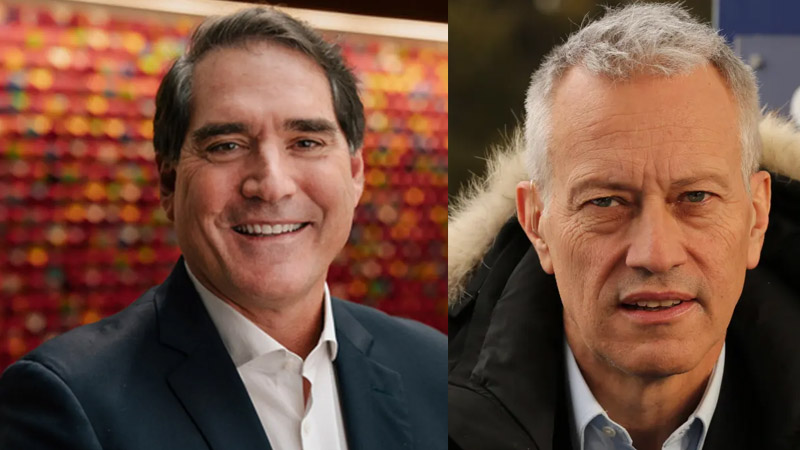
(Courtesy: The Coca-Cola Company) - (Gerry Miller | CNBC)
The veteran CEO of Coca-Cola, James Quincey, is planned to be replaced by Chief Operating Officer Henrique Braun in the next year, and the company is getting ready for a significant leadership change. Wednesday was the day when the corporation made the announcement that Braun will formally take over the post on March 31. This will be the first shift at the highest level of the organization since Quincey took over in 2017.
Additionally, Coca-Cola has announced that Braun will be considered for a position on the company’s board of directors, while Quincey will continue to serve as executive chairman. This change comes at a time when Coca-Cola and other beverage manufacturers are faced with the challenge of managing slow demand in a number of important areas. The consumption of soft drinks continues to constitute a significant portion of Coca-Cola’s worldwide sales; nevertheless, consumer patterns have evolved, especially among those with lower incomes who have reduced their purchases in recent quarters.
Quincey, who is sixty years old, shepherded the organization through a number of significant difficulties and transitions. The bottling facilities of Coca-Cola underwent a comprehensive refranchising during his tenure, a strategy change was made toward beverages that were seen to be healthier, and attempts were made to maintain the stability of the corporation despite the disruptions caused by the Covid epidemic. According to sources from The Wall Street Journal, when he was in charge of Coca-Cola, the company extended its footprint in goods other than soda and shifted its focus more aggressively toward luxury brands.
When Braun, now 57 years old, first started working for Coca-Cola in 1996, he has been there for over three decades. Before taking on the post of chief operating officer earlier this year, he had previously served in a number of leadership positions on a global and regional scale. In a statement, Coca-Cola said that Braun would give his attention to the pursuit of “new growth opportunities” all over the globe, the enhancement of the company’s capacity to satisfy the requirements of consumers, and the development of its technological and digital capabilities.
The shift in leadership comes at a time when Coca-Cola is also working to increase demand for its core soft drink line. The worldwide unit case volume had a one percent increase during the most recent third quarter, reversing the downward trend that was seen during the preceding three-month period. Despite this, Quincey has admitted that a significant number of consumers with lower incomes have been purchasing less of the company’s drinks.
As a result, Coca-Cola has been offering additional alternatives that are smaller in size and charge lower prices in order to maintain customer engagement. Traditional sodas have been experiencing headwinds, while the more expensive brands in Coca-Cola’s portfolio are beating their competitors.
An example of this would be the fact that Smartwater and Fairlife have had more robust growth than sodas, which indicates that some customers are ready to spend more money on luxury beverages even when they reduce their spending in other areas.
Additionally, throughout Quincey’s tenure as CEO, Coca-Cola has performed far better than its primary competitor, PepsiCo, in most respects. The robust out-of-home business that Coca-Cola enjoys, which includes sales via restaurants, movie theaters, and stadiums, has been a significant benefit for the company. Coca-Cola, the company’s trademark beverage, continues to be the most popular soda sold in the United States, while Sprite just surpassed Pepsi to become the third most popular soda produced in the nation.
This impetus has been mirrored in the performance of the market. The stock of Coca-Cola has increased by over 13 percent so far this year, despite the fact that prices were relatively unchanged during the after-hours trading session on Wednesday. In contrast, Pepsi has seen a decline in its share price of more than one percent over the same time period. Currently, Coca-Cola’s market capitalization is more than $300 billion, which places it far higher than Pepsi’s worth of over $200 billion.
During the time when Braun is getting ready to take on one of the most powerful positions in the global consumer goods industry, the firm is preparing itself to push through, altering market trends and discovering new methods to expand. The handoff from Quincey represents the end of a significant chapter for Coca-Cola and the beginning of a new one that will be distinguished by what Braun has termed internally as a renewed emphasis on innovation, efficiency, and global growth.
Coca-Cola History
Coca-Cola began in 1886 as a patent medicine created by pharmacist John Pemberton in Atlanta, containing extracts from coca leaves and kola nuts, leading to its name and initial promotion as a tonic for common ailments. The formula was later sold to businessman Asa Griggs Candler, who, through aggressive marketing, built it into a global brand, eventually removing cocaine and introducing iconic elements like the contour bottle to solidify its dominance in the soft drink.
Coca-Cola Company
A signature product of The Coca-Cola Company, an American multinational corporation established in 1892, Coca-Cola (Coke) is a well-known carbonated soft drink with a sweet, caramel-colored flavor with hints of vanilla and cinnamon. It comes in a variety of flavors, including Classic and Zero Sugar, and is sold all over the world as a cultural icon and part of a wide range of beverages.