
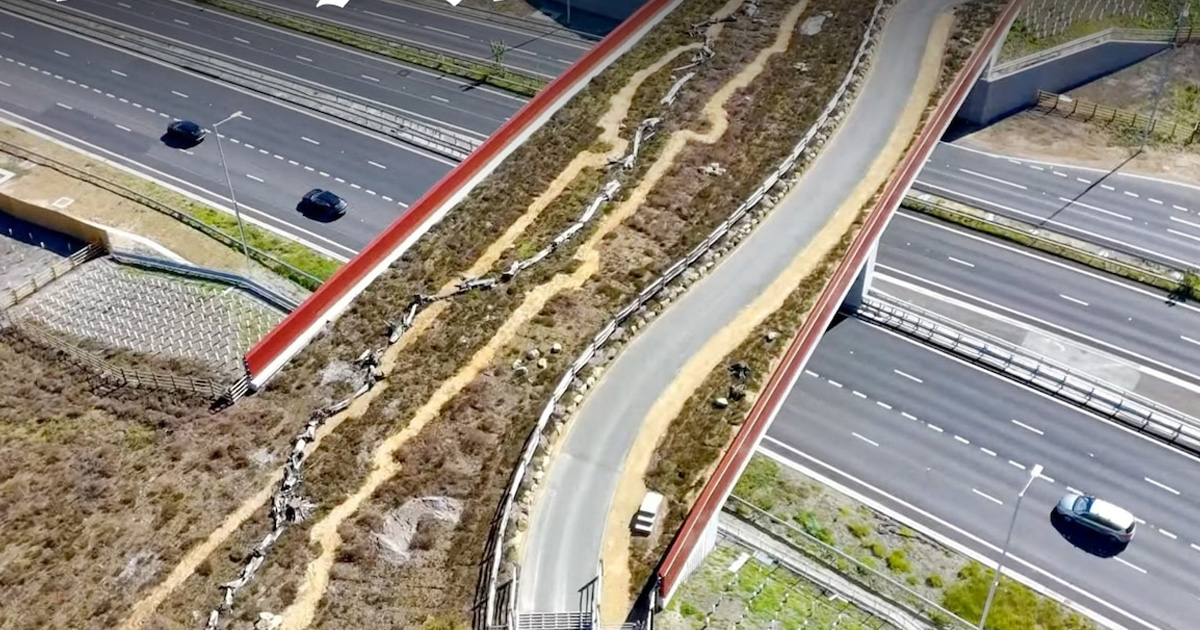
Wildlife crossing in Surrey will connect two parcels of heathland divided since road was built in 1970s (Credit: Philip Davies/Bav Media)
A £3.7 million bridge blanketed in heather and shrubs is set to open next month in Surrey, giving toads, badgers, snakes and a host of other wildlife a safe route across one of England’s busiest A-roads — and marking what is believed to be a first for Britain.
The Cockcrow Bridge stretches 68 metres across the A3 near Cobham, connecting two stretches of heathland that were effectively cut off from one another when the road was built in the 1970s. Ockham and Wisley Commons, which sit on either side of the 30-metre-wide structure, are home to grass snakes, adders, badgers, bats and toads, all of which conservationists hope will make use of the new crossing.
Rare breeding birds, including the nightjar and Dartford warbler, also depend on the heathlands. The green bridge replaces a pedestrian crossing that previously spanned the road, transforming a purely functional structure into one designed with nature in mind, according to The Telegraph.
National Highways, which maintains Britain’s major road network, said the bridge would “reconnect the commons either side of the A3 and provide a natural and safe corridor for local wildlife,” adding that “it has been designed with reptiles and invertebrates at its heart.”
Steve Elderkin, the director of environmental sustainability at National Highways, said the project reflected a broader rethinking of how roads interact with the natural world. “While roads have always connected people and places, they are too often a barrier for nature, severing habitats and contributing to the decline in biodiversity,” he said.
“Our green bridges are designed to blend with the landscape and connect habitats, animals and people, leaving a lasting legacy to ensure nature thrives.” The Cockcrow Bridge is the first of three such structures that National Highways is building across England.
In Cornwall, the Marazanvoze bridge will span the A30, providing safer passage for badgers and voles across the south-west’s main arterial route. A third bridge in Gloucestershire will carry a hedgerow-lined grassland corridor over the A417, running alongside a dedicated path for pedestrians, horse riders and cyclists on the 100-mile Gloucestershire Way walking route.
The push for wildlife-friendly infrastructure extends beyond the road network. The HS2 railway project linking London to Birmingham will include 16 green bridges and five green tunnels along its route.
The scale of that commitment came into sharp focus in 2024, when the chair of HS2 Ltd revealed the project would spend £100 million on a dedicated bat tunnel, required to satisfy Natural England, given the protected status of the species. With the Cockcrow Bridge set to open in the coming weeks, conservationists hope it will serve as a blueprint for how major roads and wildlife can, eventually, coexist.