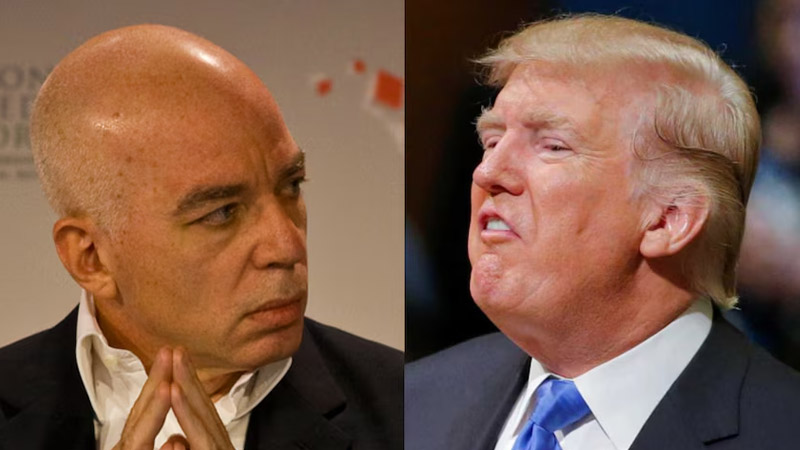
Michael Wolff said Trump’s response to the tragedy showed behavior that should deeply concern the public (Supplied/Reuters)
As a result of a contentious social media remark that was made in response to the murder of director Rob Reiner and his wife, a veteran chronicler of Donald Trump is expressing concerns about the president’s judgment. On Tuesday, Michael Wolff, a writer and novelist, said that President Trump’s reaction to the tragedy demonstrated conduct that ought to gravely alarm the public. He argued that the president seemed to be really “off his f—— rocker.”
Wolff, who has authored four books on Trump over the course of the previous few decades, made the comments on Inside Trump’s Head, a podcast that he co-hosts with Joana Coles of The Daily Beast. Immediately upon the news that Reiner, a longstanding and vocal opponent of Trump, had been slain at his home in Los Angeles together with his wife, Michele, the conversation concentrated on a post that Trump had made on Truth Social.
Trump asserted in his article that Reiner was suffering from “Trump Derrangement Syndrome” and made a veiled reference to the possibility that this disease had a role in Reiner’s death. The statements were met with swift criticism because they seemed to politicize a horrific crime and because they targeted a guy who had just been slain prior to the words being made.
Wolff presented Trump’s response as part of a larger and more alarming trend, implying that it showed an escalating lack of discipline rather than a single fall in self-control.
“Just because your older parent, for example, is showing signs of losing it, does not mean that they will not continue down the road of losing it for quite some time,” Wolff said. “As anyone who has been through this can attest, we know that this is something that everyone has experienced.” There is still a period of three years left.
Over the weekend, the bodies of Reiner and his wife were discovered, and since then, the police have accused their son, Nick, of two charges of first-degree murder. It has rekindled concerns about family violence, mental health, and access to firearms, and it has horrified the entertainment industry in Hollywood. When seen against this context, the choice that Trump made to step in with a personal and political insult was shocking to many onlookers.
According to Wolff, Trump’s response had neither a strategic nor a political goal, and it could only be detrimental to him, especially because people are already apprehensive about his temperament. However, according to Wolff, Trump seems to be unconcerned with how others react to statements of this kind.
The comments made by Wolff were in reference to worries over Trump’s age. “You fall asleep, okay, it’s not a good look, but it’s not really your fault,” Wolff said. ” However, this is something that should have been addressed, and it was superfluous for him to say anything, to have immersed himself in the situation. This is an example of derrangement since it is something that has been done proactively that will not produce anything.
The author drew a comparison between circumstances that are inescapable for humans, such as exhaustion, and what he referred to as a choice that was both voluntary and foolish, which was to insert himself into a delicate position. As far as Wolff is concerned, the event exemplifies Trump’s tendency to dominate every news cycle, even when remaining silent would be the most prudent course of action.
Wolff has been characterised as antagonistic and unreliable by Trump’s followers, who have often pointed to previous disagreements with the sources used in Wolff’s books. Nevertheless, Wolff’s critique is a reflection of an increasing number of analysts who claim that Trump’s conduct in public has gotten more unpredictable during his current tenure in office.
The White House has not provided a formal response to either the criticism that has been directed at Trump’s tweet regarding Reiner or the comments that Wolff has made. While everything is going on, Trump has continued to post on Truth Social at a high rate, mostly focused on political opponents, perceived enemies in the media, and grievances from previous conflicts.
According to Wolff, the situation is more than just a matter of a poor message or poor optics. His interpretation of it was that it was an indication that Trump is becoming more and more unfiltered, even when he is responding to situations that include death and violence.
In a normal situation, political leaders from all different parties would express their condolences in response to the murder of Rob Reiner and his wife. Instead, Trump’s answer has become the tale itself, which has fueled discussion about the standards of the presidency, regarding empathy, and regarding mental competence.
As Wolff put it, the fear is not that Trump made a single insulting statement; rather, it is that he is growing more adept at making such remarks and that it is becoming more difficult to anticipate them. Considering that there are still years remaining in the term, Wolff cautioned that the public may need to prepare themselves for other incidents that push the limits of what Americans anticipate from their heads of state.