
(Genaro Molina/Los Angeles Times via Getty Images)
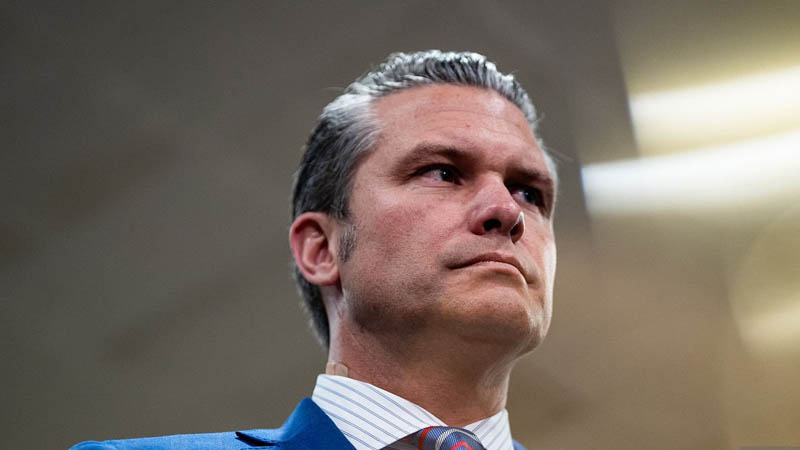
Pete Hegseth, the Secretary of Defense, has said that he intends to revamp the Pentagon by using Elon Musk’s failed experiment with the Department of Government Efficiency. He is not pretending that this would be a smooth process. During a visit to Musk’s SpaceX Starbase facility in Texas on Monday, Hegseth informed staff that he plans to chop through bureaucracy, stating that he would like to do it with a chainsaw.
It was a part of Hegseth’s month-long national “Arsenal of Freedom” tour, which he has framed as an effort to restore and reinvigorate the military industrial base in the United States of America. An appearance was made as part of this trip. The military chief, who is 45 years old, has referred to the trip as a “call to action to revitalize” both the sector and its workers. His address at Starbase focused mainly on topics related to speed, disruption, and radical change.
“This is about building an innovation pipeline that cuts through the overgrown bureaucratic underbrush and clears away the debris, Elon-style, preferably with a chainsaw,” Hegseth said to the gathering, which drew cheers. “This is about building an innovation pipeline.” He said, “Now, I want this audience to know that we also have the backs of innovators who share that very same urgency.”
In doing so, he positioned himself and President Donald Trump as supporters of innovators in both the business sector and the military. According to Hegseth, the modifications that he wishes to make are motivated by what he considers to be the urgent requirements of the United States military personnel. “I demand, and we demand that we arm our war fighters with overwhelming and lethal technology right now,” he declared, adding that he had sworn in “ten more” military personnel earlier that day.
He also said that he had promised to do so. In little more than ten years.” The observations are noteworthy due to the fact that Musk himself has admitted that the cost-cutting project known as DOGE, which he temporarily supervised inside the Trump administration, was unsuccessful. A recent chat that took place between Elon Musk and Katie Miller, a former employee of DOGE and a podcast presenter, revealed that Musk stated, “We were a little bit successful, we were somewhat successful.”
It was in June of last year that he wrote on X that President Donald Trump was included in the Epstein files, which resulted in the sudden termination of his position inside the government. “I don’t think so,” Musk responded to Miller’s question on whether or not he would repeat the experience. I believe that if I had been working on my enterprises, I would have been able to build them instead of making digital currency transactions.
He continued by saying, “The cars… they wouldn’t have been burning the cars.” This was in reference to the response that Tesla experienced during the period that he was advocating for significant cutbacks to several government programs. In spite of that record, Hegseth has made it quite obvious that he intends to directly integrate many more of Musk’s technologies into the operations of the Pentagon.
It was verified by him that the department intends to use Google’s generative AI systems in addition to the artificial intelligence tool Grok developed by Elon Musk. This decision comes at an embarrassing time for Grok, which has been subjected to criticism from throughout the world after users were able to produce sexualized photographs of minors using the application.
The debate has already resulted in Grok being temporarily restricted in Malaysia and Indonesia, where it was previously available. This week, the organisation that oversees media in the United Kingdom, known as Ofcom, made the announcement that it would begin an inquiry into Musk’s X platform. This action may eventually result in a ban.
Hegseth seemed to disregard such worries while also assuring them that Grok will soon be operational inside the systems of the Defense Department. In addition to stating that the tool would not be “woke,” he also claimed, “Very soon, we will have the world’s leading AI models on every unclassified and classified network throughout our department.” This is long overdue.”
A stringent requirement for artificial intelligence in the military was outlined by him. It is said by Hegseth that the United States Department of Defense “would not employ AI models that will not allow you to fight wars.” Based on this criterion alone, we shall evaluate AI models. information that is factually correct and pertinent to the goal, free from ideological restraints that restrict authorized military uses.

He emphasised the importance of that message by delivering an even more pointed phrase, which read, “The Department of War AI will not be woke.” It will be effective for us. We are not developing chatbots for an Ivy League faculty lounge; rather, we are developing weapons and systems that are ready for war.
The visit to Starbase was only one of several visits on a hectic day. Earlier on Monday, Hegseth showed up at Lockheed Martin’s Fort Worth plant, where F-35 fighters and other military aircraft are built. He also spoke about how important and necessary change is, saying that the reason he came was not just to promote the production of defense-related items in the US, but also to set the stage for major structural changes inside the Pentagon itself.
As of now, it is unknown if Hegseth’s chainsaw strategy will be successful in the same way that Musk’s DOGE experiment was unsuccessful. He is openly aligning the future of the Defense Department with a vision of disruption, speed, and ideological clarity. This is the case even though some of the tools and models that he is adopting continue to face increased criticism all around the globe.