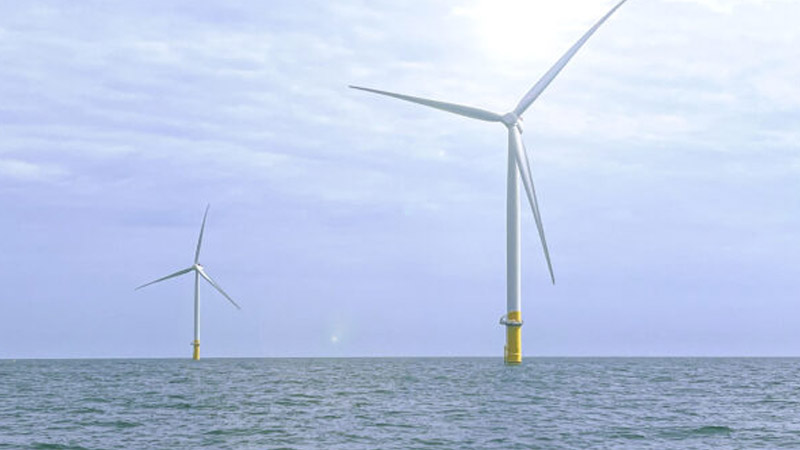
he administration paused leases for Vineyard Wind 1 off Massachusetts, Revolution Wind off Rhode Island, (Photo by Stephen Boutwell/Bureau of Ocean Energy Management)
In a single move on Monday, the Trump administration brought the U.S. offshore wind industry to a standstill, freezing construction on the nation’s largest project and four other major developments along the East Coast. The sudden halt sent shockwaves through both the renewable energy sector and financial markets.
The immediate fallout was stark. Shares of Dominion Energy, the utility behind the massive Coastal Virginia Offshore Wind project, dropped nearly 4%. International developers were hit even harder, with Denmark’s Ørsted plummeting 11% and Norway’s Equinor falling about 1%.
The suspension spans five key projects:
Coastal Virginia Offshore Wind (176 turbines)
Vineyard Wind 1 (Massachusetts)
Revolution Wind (Rhode Island)
Sunrise Wind (New York/New England)
Empire Wind 1 (New York)
Together, these projects were projected to generate enough clean electricity to power over 2 million homes, according to their developers—a promise now cast into uncertainty.
The rationale offered by the administration centered on national security. Interior Secretary Doug Burgum cited Pentagon concerns that the massive turbines create radar interference, with the Interior Department explaining that the structures “obscure legitimate moving targets and generate false targets” through blade movement and highly reflective towers.
This justification has been met with fierce pushback, particularly regarding the Coastal Virginia project a cornerstone development designed to power more than 600,000 homes and slated for completion next year.

Dominion Energy issued a sharply worded response, warning of “severe ramifications.” The utility argued that delaying the project “will threaten grid reliability for some of the nation’s most important war-fighting, AI, and civilian assets,” while also driving up energy costs and endangering thousands of jobs.
The stakes are especially high in Virginia, home to the world’s largest concentration of data centers. Surging electricity demand from artificial intelligence has made reliable, affordable power a critical concern. Dominion and state leaders have positioned offshore wind as essential to meeting that demand without skyrocketing prices.
Political reactions split along predictable lines. Virginia’s Republican Governor Glenn Youngkin has expressed support for the project, while incoming Democratic Governor Abigail Spanberger campaigned on expanding renewable energy to curb rising costs. In Washington, Senate Minority Leader Chuck Schumer blasted the decision as “unhinged, irrational, and unjustified,” predicting it would “drive energy bills even higher.”
The administration’s freeze aligns with President Trump’s broader offensive against wind energy, which began on January 20 with an executive order halting all new wind leases pending a federal review. That order, however, recently faced a judicial setback. Earlier this month, a federal judge in Massachusetts ruled Trump’s earlier wind development halt “arbitrary and capricious and contrary to law,” a precedent that raises serious questions about whether this latest suspension will survive legal challenge.
For now, the future of American offshore wind hangs in the balance, caught between national security arguments, economic urgency, political ideology, and the looming prospect of another courtroom battle.