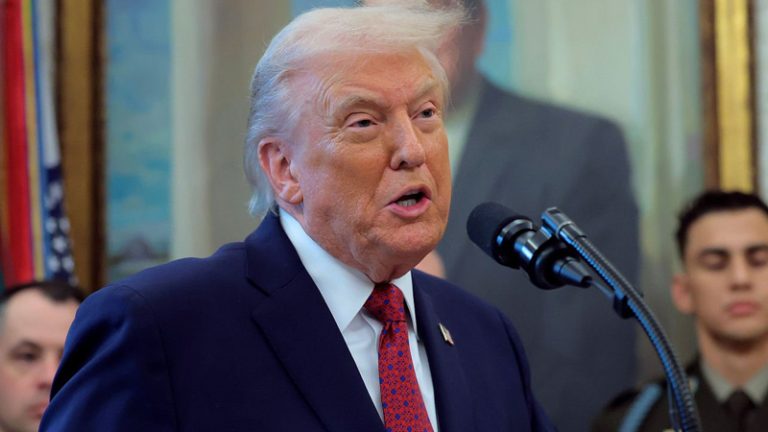
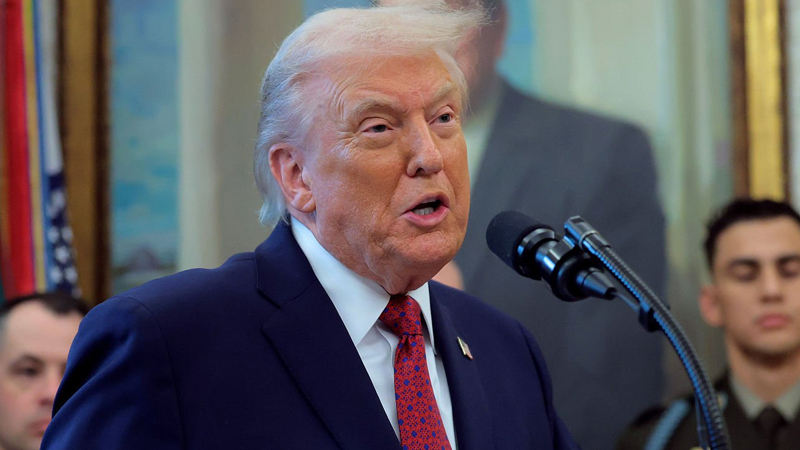
(Photo by Anna Moneymaker/Getty Images)
The United States has collected over $200 billion in tariffs in 2025 as a result of new duties imposed by President Donald Trump, the Customs and Border Protection (CBP) agency revealed on Monday. However, the legality of these new tariffs is currently under scrutiny as the U.S. Supreme Court considers arguments that the duties are unconstitutional.
The $200 billion figure refers solely to the new tariffs introduced this year. These tariffs are distinct from those imposed during Trump’s first term, which are not currently facing legal challenges. The new tariffs, however, have sparked controversy due to their unilateral imposition without congressional approval.
Since January, President Trump has introduced what he calls reciprocal tariffs on imports from most of the world’s nations. Additionally, he imposed what have been dubbed “fentanyl tariffs” on products from countries like Canada, China, and Mexico, in response to their alleged failure to curb the flow of fentanyl into the U.S.
“Between Jan. 20 and Dec. 15, 2025, U.S. Customs and Border Protection collected more than $200 billion in tariffs thanks to more than 40 executive orders put in place by President Donald Trump’s Administration,” CBP said in a statement.
The agency added, “This figure underscores CBP’s effectiveness in promoting secure, fair, and compliant trade, strengthening America’s national and economic security.” Despite this substantial revenue, tariff collections declined in November. It marked the first drop since Trump first introduced his extensive tariffs in April.

The government collected $30.75 billion in tariffs in November, slightly lower than the $31.15 billion collected in October. Experts attribute the decline to a slowdown in freight shipments to the U.S., as well as Trump’s decision to lower some of the duties.
“CBP’s enforcement delivers results,” said CBP Commissioner Rodney Scott in a statement. “By combining intelligence-led targeting, rigorous oversight, and swift action, we are safeguarding the U.S. economy, protecting American industries, and holding accountable those who seek to break our trade laws.”
While CBP stands behind the effectiveness of the tariffs in bolstering the U.S. economy, the legal landscape surrounding them has become increasingly uncertain. The U.S. Court of Appeals for the Federal Circuit ruled in August that Trump did not have the authority to impose these tariffs without congressional approval. The court found that the power to impose taxes such as tariffs is “vested exclusively in the legislative branch by the Constitution.”
“The core congressional power to impose taxes such as tariffs is vested exclusively in the legislative branch by the Constitution,” the Federal Circuit stated in its ruling. “Tariffs are a core congressional power.” As the case now heads to the U.S. Supreme Court, a ruling could potentially have significant implications. If the Court finds that Trump’s new tariffs are illegal, companies that have already paid the duties could be entitled to refunds.
One of the most notable companies challenging the tariffs is the retail giant Costco. In late November, Costco joined a group of other companies suing the Trump administration to seek a full refund for the tariffs they have paid so far in 2025. The companies are also asking the court to block further collection of the duties while the legal case proceeds.
The legal battle over Trump’s tariffs could lead to significant changes in U.S. trade policy. As the Supreme Court deliberates, the outcome of the case could alter the future of tariff enforcement, impacting companies and consumers alike. With more than $200 billion already collected, the stakes remain high as the legal challenge continues.
About the Author